Busan is squeezed between mountains and the sea, and the easiest way across it is the Busan Metro (부산도시철도, Busan dosi cheoldo). Line 1 gets you to Busan Station and Nampo. Line 2 serves Haeundae and Gwangalli, with a transfer at Seomyeon. The Donghae Line takes you out to Osiria. If this is your first trip to Korea, keep my Korea trip planner for first-timers open too.
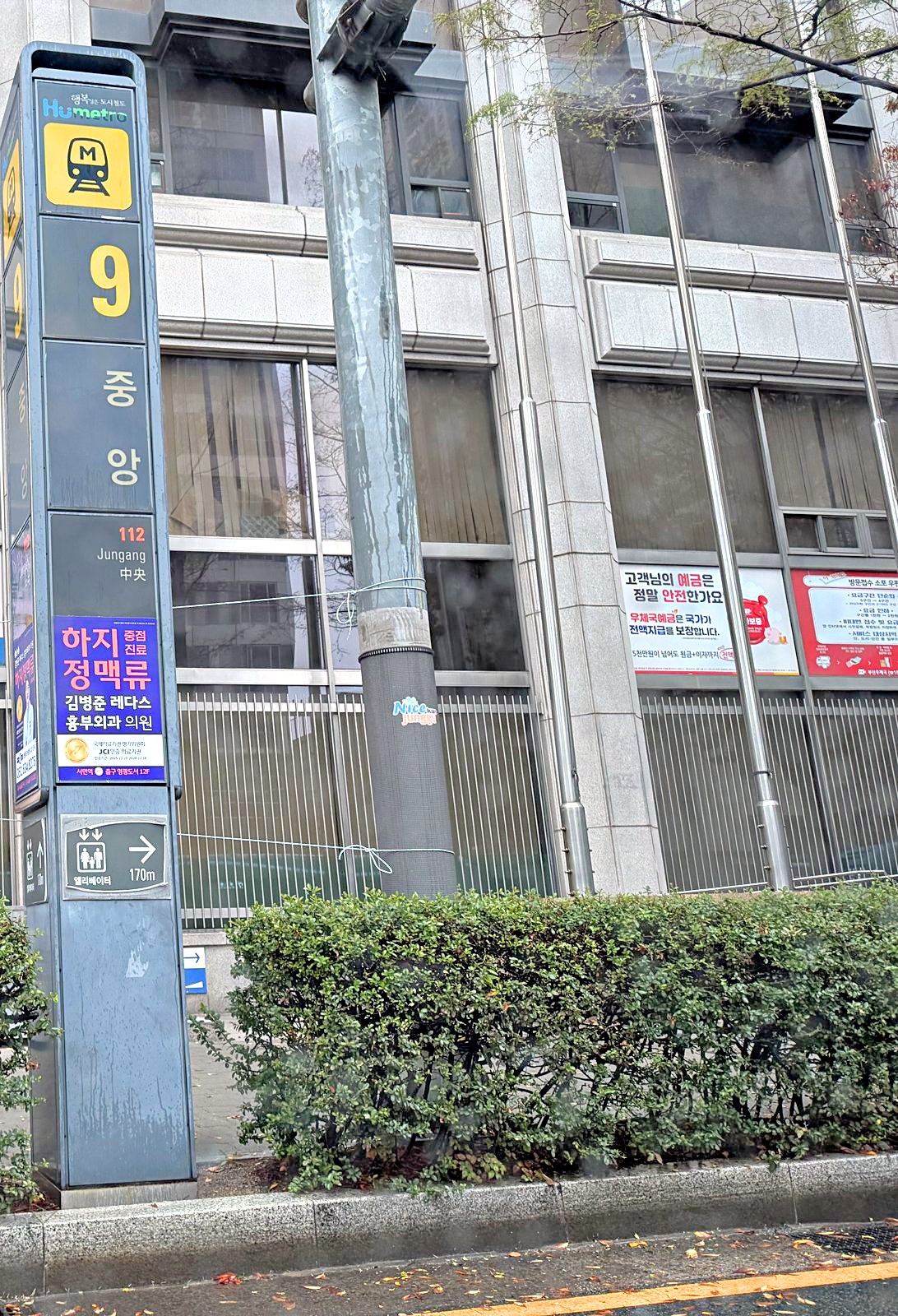
A Busan Metro entrance (Jungang Station, Line 1). Photo: Jin from Korea
Busan Subway at a Glance
| Ride | Transport card | Single ticket |
|---|---|---|
| Section 1 (up to 10 km) | ₩1,600 | ₩1,700 |
| Section 2 (over 10 km) | ₩1,800 | ₩1,900 |
- The table shows adult fares on Busan Metro Lines 1–4. Children aged 6–12 can ride free with a registered child transport card. A child’s single-use QR ticket costs ₩700 for Section 1 or ₩800 for Section 2. See the official Busan Metro fare table.
- Section 1 or 2 depends on the distance from the station where you board; the gate or ticket machine works it out for you.
- App passes: The adult 1-day pass is ₩6,000 and the adult 3-day pass is ₩13,000. They cover Lines 1–4 only. Buses, the Donghae Line and the Busan–Gimhae Light Rail are excluded.
Operating Hours: How to Check the First and Last Train
Busan Metro generally runs from around 5 am to around midnight. The first and last trains depend on your station, direction and travel day.
- Check your departure station. Open the official station timetables, select your line and station, then check your direction and the weekday, Saturday, or Sunday and holiday schedule. The official Busan Metro map in English helps you identify your line and transfer station.
- Check where the train ends. A late train can stop short of the end of the line. Make sure your destination or transfer station is on that train’s route.
- Work backward from your last connection. For Haeundae to Nampo, check the last Line 1 train from Seomyeon that stops at Nampo, then pick a Line 2 train from Haeundae that gets you to Seomyeon in time to walk between platforms. Your last usable departure can be earlier than the last train on your first line.
The Four Busan Metro Lines
Busan Metro has four numbered lines; visitors mostly use Lines 1 and 2.
- Line 1: runs north–south from Nopo to Dadaepo Beach through Busan Station, Nampo, Jagalchi and Seomyeon. This is your line for the KTX station and the old downtown.
- Line 2: runs from Jangsan in the east through Haeundae, Gwangan and Seomyeon to Sasang and Yangsan. This is the beach line.
- Line 3: links Suyeong with Yeonsan, Deokcheon and Daejeo. Useful if you come in from Gimhae Airport.
- Line 4: a short line from Minam to Anpyeong in the northeast. Most tourists never need it.
Two more rail lines join the network. The Donghae Line (동해선), run by Korail, follows the east coast from Bujeon to Osiria, Gijang and on to Ulsan. The Busan-Gimhae Light Rail (부산김해경전철) runs from Gimhae Airport Station to Sasang on Line 2 and Daejeo on Line 3, so you can reach the subway straight from the airport (step-by-step in my Gimhae Airport to Haeundae and Seomyeon guide).
Fares and How to Pay
Busan uses a simple two-section system: up to 10 km from your boarding station is Section 1, anything longer is Section 2. You never calculate it yourself; the gate or ticket machine does.
T-money or another transport card (easiest)
A transport card is the cheapest and simplest way to ride. Busan Metro accepts T-money, the same card you may already have from Seoul, as well as Busan’s own cards such as Cashbee and mybi. Buy one at a convenience store or at the card machine in a station, then top it up with cash at the station machines (in steps of ₩1,000). It saves ₩100 per ride over a single ticket and gives you bus transfer discounts. My T-money card guide covers buying, topping up and getting your balance back.
Single-journey QR ticket
Buy a single-use QR ticket (1회용 승차권, ilhoeyong seungchagwon) from the ticket machine. Pick your destination, pay, and scan the QR code at the gate. Keep it so you can scan it again when you exit. The ticket covers Busan Metro Lines 1–4.
At stations with upgraded machines, you can pay for the ticket with cash or a supported overseas Visa, Mastercard or JCB credit card. According to the October 2026 rollout announcement, the Dadae section of Line 1 and Line 4 were scheduled to get card payments in December 2026. If a machine only takes cash, you can also buy a mobile ticket in the app.
Busan Metro app
In the official Busan Urban Railway app, visitors can use guest access with an email address and verification code to buy a mobile ticket or a 1-day or 3-day pass. The app supports overseas Visa, Mastercard and JCB cards for these purchases. At the gate, use the QR ticket or a transport card.
Transfers: Lines, Buses and the Donghae Line
Changing between Busan Metro lines happens inside the station with no extra ticket: you pay one fare for the whole ride. Just follow the colored signs. The main transfer stations are:
- Seomyeon: Lines 1 and 2 (the busiest, and changing lines can mean a long walk)
- Yeonsan: Lines 1 and 3
- Suyeong: Lines 2 and 3
- Deokcheon: Lines 2 and 3
- Dongnae: Lines 1 and 4
- Minam: Lines 3 and 4
With a transport card, eligible transfers between the metro, bus and other operators can receive a discount. Tap out and board the next service within 30 minutes. The rules allow up to two eligible transfers. The operator gives Line 2 → Donghae Line → Line 1 as an example where a new base fare applies when you re-enter the metro. See the official transfer fare rules for the details.
To change to the Donghae Line, tap out of Busan Metro and tap in at the Donghae Line gates. Follow the transfer signs at Gyodae (Line 1), BEXCO (Line 2) or Geoje (Line 3). At Bujeon, the Line 1 subway station and Korail’s Bujeon Station are separate. You’ll need to exit and walk between them. For a signed Line 1 connection, use Gyodae.
Key Stations for Visitors
Seomyeon (Lines 1 and 2)
Seomyeon is Busan’s shopping and nightlife center and the hub where Lines 1 and 2 meet. The station is huge, with an underground shopping street, so check your exit number in Naver Map first. Staying here puts both the beaches and the old downtown one line away.
Haeundae (Line 2)
For Haeundae Beach, ride Line 2 to Haeundae Station. Busy Haeundae Market is about five minutes from Exit 3; see my Haeundae Market street food guide. The Paradise Hotel Busan is about a 10-minute walk from Exit 3 or 5. If you are staying at the western end of the beach near Dongbaek Island, where The Westin Josun sits, compare walking times from Dongbaek Station, one stop earlier, in Naver Map.

Haeundae Beach at night. Photo: Jin from Korea
Three stops before Haeundae, Centum City Station is the stop for the Haeundae River Cruise (Exit 12), and the next stop toward Haeundae, BEXCO, is where you change to the Donghae Line for Songjeong and Osiria.

The Haeundae Beach area, with The Westin Josun on the right. Photo: Jin from Korea
Gwangalli: Gwangan or Geumnyeonsan (Line 2)
Gwangalli Beach and its bridge view sit between two Line 2 stations, Gwangan and Geumnyeonsan. Both are walkable, so pick whichever is closer to your café or hotel in Naver Map.
Nampo and Jagalchi (Line 1)
Nampo and Jagalchi are neighboring stations on Line 1. Use Jagalchi Exit 7 for Gukje Market or Jagalchi Exit 3 for Bupyeong Kkangtong Market. If you’re starting on Gwangbok-ro, use Nampo Exit 7 and follow the Nampo-dong market walking route through the markets to BIFF Square. From this area, buses and taxis go on to the Songdo Marine Cable Car.
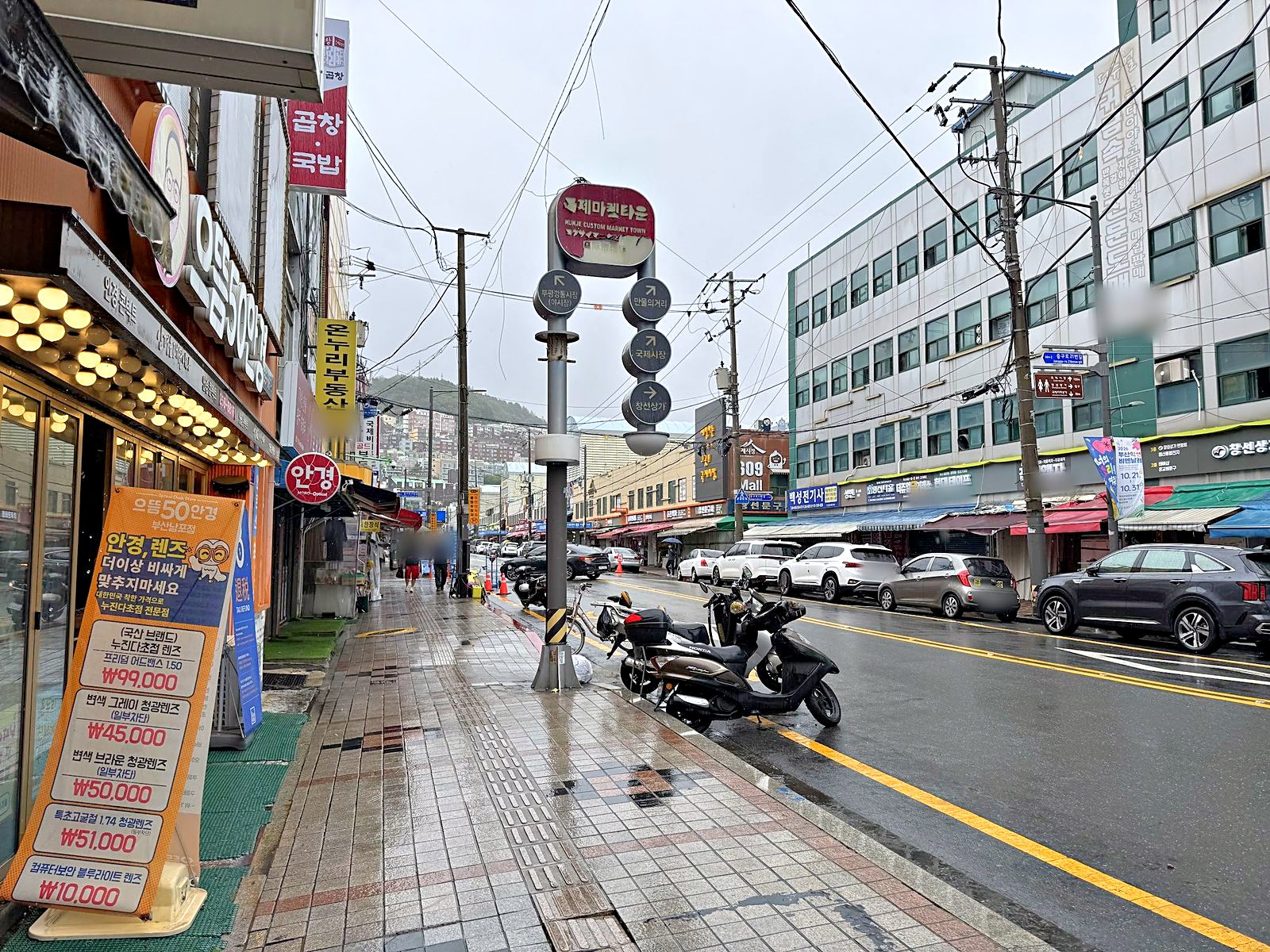
A street near Gukje Market, Busan. Photo: Jin from Korea
Busan Station (Line 1)
If you arrive by KTX, the Line 1 subway station is right by the train station. Take Line 1 south for Nampo (two stops) or north for Seomyeon, and change at Seomyeon for Line 2 toward Haeundae. My KTX booking guide covers the trip from Seoul.
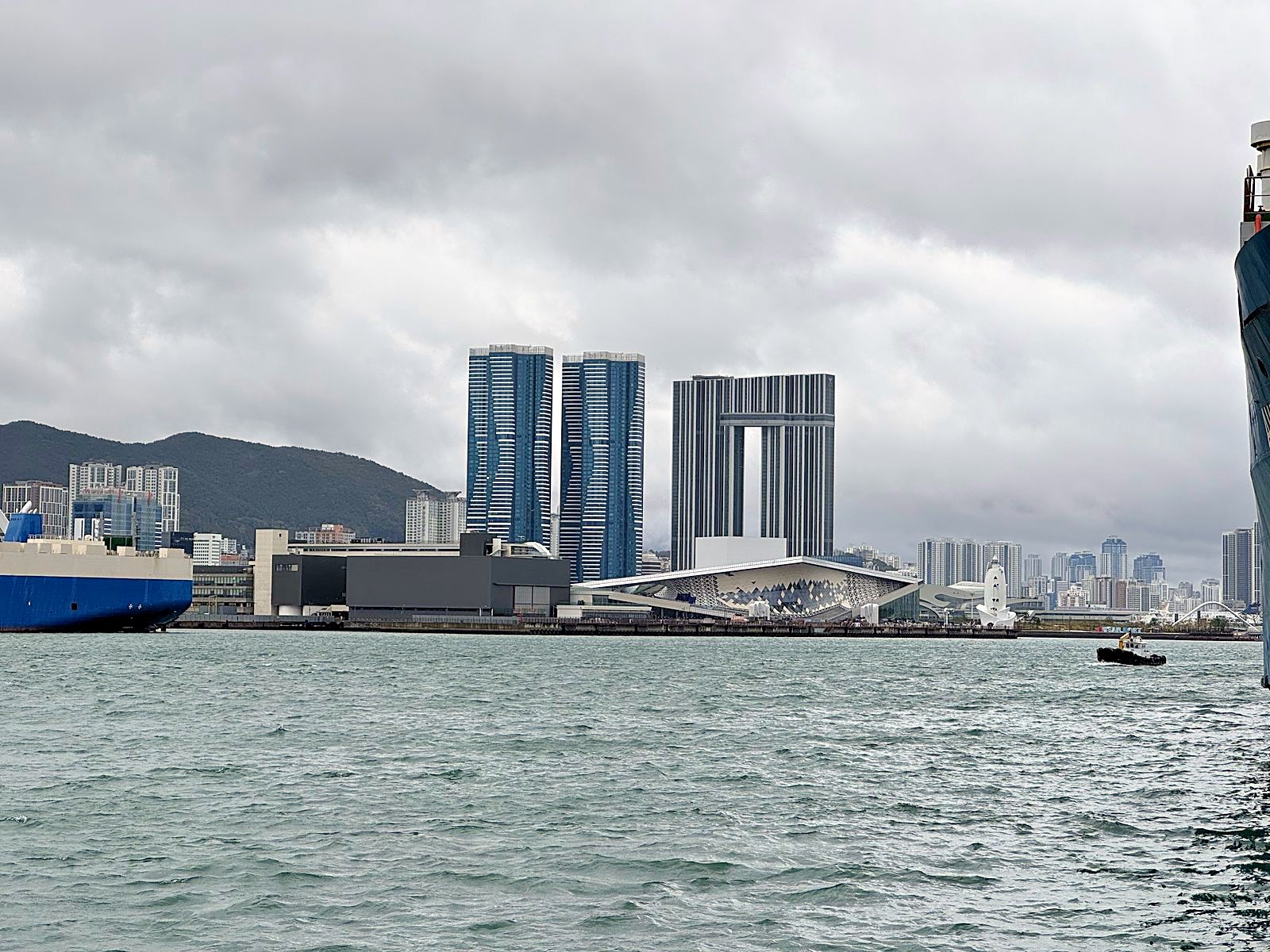
Busan harbor, seen from Yeongdo. Photo: Jin from Korea
Donghae Line to Osiria (Lotte World, Luge and Outlets)
Osiria Station is on Korail’s Donghae Line. From Haeundae Station, take Line 2 two stops to BEXCO and change to a Donghae Line train that stops at Osiria, after Sinhaeundae and Songjeong. From Seomyeon or Busan Station, take Line 1 to Gyodae and follow the Donghae Line transfer signs. T-money works on the Donghae Line. Donghae Line trains generally run less often than the metro, so check the next departure and stops in Naver Map before you leave.
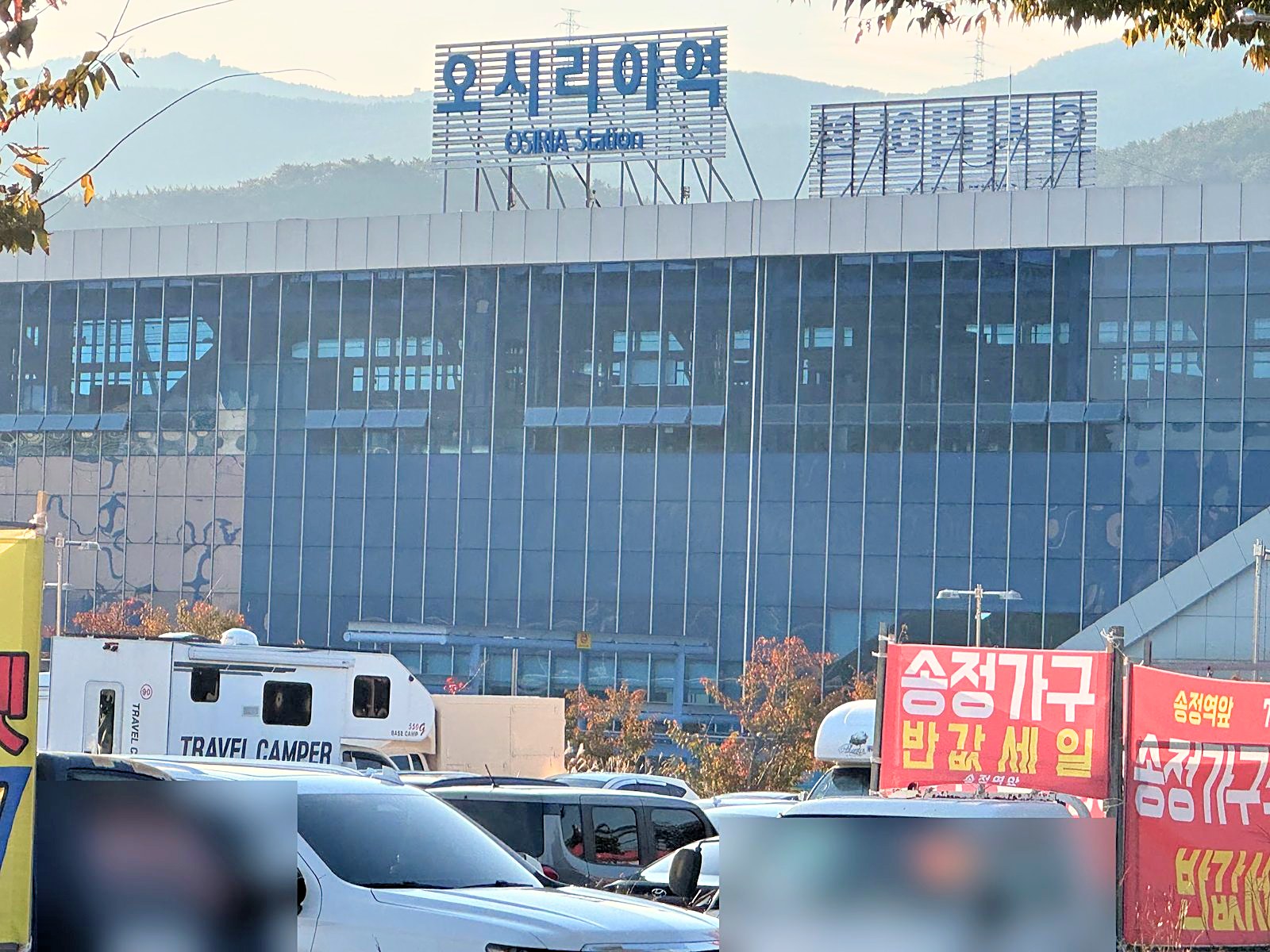
Osiria Station, East Busan. Photo: Jin from Korea
Leave Osiria Station by Exit 1; the Osiria tourist complex is all around it:
- Lotte Premium Outlets Dongbusan: about a 7–10 minute walk.
- Lotte World Adventure Busan: roughly a 10–15 minute walk.
- Skyline Luge Busan: a longer walk (around 20 minutes) up toward Haedong Yonggungsa, so a short taxi ride with Kakao T is handy. You can buy luge tickets at the park or check the official luge site.
The Donghae Line also stops at Songjeong, one stop before Osiria, which is the easy way to reach Songjeong Beach for surfing.
Tips from a Local
- Check the direction before the gate. Some stations have separate entrances for each direction. Signs show the final stop, for example “Jangsan” for Haeundae on Line 2.
- Use Naver Map for exits. Its transit directions show the exit number to use. See my map apps comparison.
- Keep ₩5,000–10,000 on your card for days that mix subway, bus and Donghae Line.
- Avoid rush hour with luggage, especially at Seomyeon.
📍 Copy & Paste into Naver Map
Tap a link to open the place in Naver Map, or copy the Korean name into the search box.
- 서면역 (Seomyeon Station) — Open in Naver Map
- 해운대역 (Haeundae Station) — Open in Naver Map
- 남포역 (Nampo Station) — Open in Naver Map
- 자갈치역 (Jagalchi Station) — Open in Naver Map
- 오시리아역 (Osiria Station) — Open in Naver Map
New to Naver Map? See my Google Maps vs Naver Map vs KakaoMap guide.
📋 Copy & Paste Korean
Copy the Korean text into Naver Map or Papago, or show it on your phone to station staff.
Words and places
- 지하철 (jihacheol) — subway
- 환승 (hwanseung) — transfer
- 출구 (chulgu) — exit
- 교통카드 (gyotong kadeu) — transport card
- 충전 (chungjeon) — top-up
- 동해선 (donghaeseon) — Donghae Line
Phrases
- 해운대 해수욕장은 몇 번 출구예요? (haeundae haesuyokjang-eun myeot beon chulgu-yeyo?) — Which exit for Haeundae Beach?
- 어디서 갈아타요? (eodiseo garatayo?) — Where do I transfer?
- 이거 해운대 가는 열차예요? (igeo haeundae ganeun yeolcha-yeyo?) — Is this the train to Haeundae?
- 오시리아역은 어떻게 가요? (osiria-yeogeun eotteoke gayo?) — How do I get to Osiria Station?
- 교통카드 충전하고 싶어요. (gyotong kadeu chungjeonhago sipeoyo) — I’d like to top up my transport card.
FAQ
Can I use my Seoul T-money card in Busan?
Yes. T-money works on Busan Metro, buses and the Donghae Line, and you can top it up with cash at Busan station machines.
Can I tap my foreign credit card at the gate?
No. Use a transport card or scan your QR ticket at the gate. Supported foreign cards can buy a ticket in the app or at upgraded station machines.
Is the 1-day pass worth it?
An adult 1-day pass costs ₩6,000. Four separately charged adult rides on Lines 1–4 cost ₩6,400–₩7,200 by transport card, so the pass starts saving money at four such rides. Count paid rides, since changing between Metro lines inside the gates is part of the same ride. The pass excludes buses, the Donghae Line and the Busan–Gimhae Light Rail.
Does the subway run all night?
No. If you’re traveling late, use the first and last train instructions above to check the last departure that can get you to your destination.
Plan the Rest of Your Trip
Busan’s subway is cheap and easy once you have a card. Heading to Seoul from Busan? See my KTX booking guide. For transport, money, apps and where to stay in one place, start with my Korea trip planner for first-timers. Enjoy Busan!
Leave a Reply