Every Korean neighborhood has a 중국집 (jungguk-jip), a Korean-Chinese restaurant with red lanterns, a long wall menu and two dishes that outsell everything else: jjajangmyeon (black bean noodles) and jjamppong (spicy seafood noodle soup). If I want both flavors, I order black bean noodles and get the spicy soup with rice. If you’re choosing just one bowl, use Shin Ramyun as your heat reference.
Quick answer: which should I order?
- Not into spicy food? Order jjajangmyeon (짜장면): mild, sweet-salty black bean sauce.
- Love spicy soup? Order jjamppong (짬뽕): red seafood broth, often about as hot as Shin Ramyun.
- Two people? One jjajangmyeon + one jjamppong (or jjamppong-bap with rice), and add a small tangsuyuk (sweet and sour pork) or a set menu.
- Typical prices: often around 6,000 to 9,000 won for jjajangmyeon and 8,000 to 11,000 won for jjamppong, but they vary by shop and area (central Seoul is often higher).
Vegetarian or avoiding an ingredient? Standard jjajang sauce usually contains pork. For jjamppong, ask what’s in the toppings and broth, which often contains seafood. If you have a food allergy, tell staff which ingredient you need to avoid and ask about shared cookware or utensils.
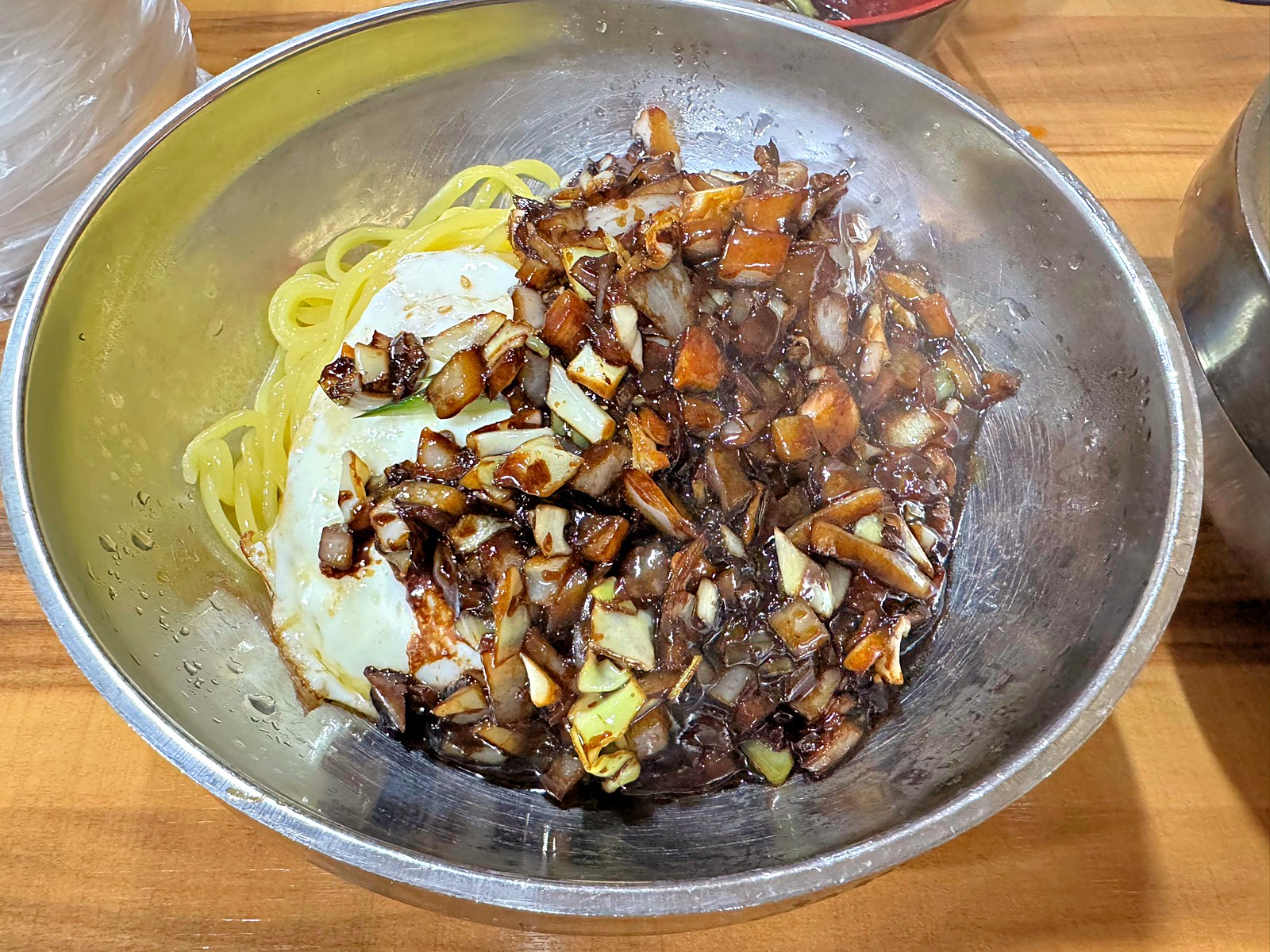
Jjajangmyeon with chunky black bean sauce and a fried egg. Photo: Jin from Korea
What Is Jjajangmyeon?
Jjajangmyeon is wheat noodles topped with a thick sauce made from chunjang (춘장, black bean paste) fried with onion, pork and sometimes zucchini or cabbage. It came to Korea from Chinese zhajiangmian, but the Korean version is darker, glossier and noticeably sweet-salty.
The black color makes some first-timers hesitate. Do not let it. Korean kids absolutely love jjajangmyeon, it is the classic “moving day” meal, and on Black Day (April 14) single people famously eat it together. Mix the sauce and noodles well with your chopsticks before the first bite, and expect a little sauce on your shirt.
Is Jjamppong Spicy? The Shin Ramyun Test
Jjamppong is a big bowl of noodles in red, smoky broth with mussels, squid, shrimp, sometimes crab, onion and cabbage. It is the spicy one, and it can be quite spicy for visitors. My simple test: have you tried Shin Ramyun? A standard jjamppong is often around that heat level, though it varies by shop.
If you have never tried it, grab a cup of Shin Ramyun at a convenience store first (see my Korean convenience store guide). If that felt hot, start with jjajangmyeon. You can ask for 덜 맵게 (less spicy), but many shops make the broth in advance, so not every place can change it. Some restaurants also offer a white 백짬뽕 (baek-jjamppong). Ask how spicy it is before ordering.

Jjamppong with crab and mussels, served with rice as jjamppong-bap. Photo: Jin from Korea
Jjajang vs Yuni-jjajang vs Ganjjajang
Look for these names when you’re choosing a black bean noodle dish:
- Jjajangmyeon (짜장면): the standard bowl has pieces of pork and vegetables in a loose, starch-thickened black bean sauce, usually poured over the noodles.
- Yuni-jjajang (유니짜장): the meat and vegetables are finely minced, giving the sauce a more even texture. This is the version listed on the photographed menu below.
- Ganjjajang (간짜장): “gan” comes from the Chinese word for dry. The sauce is stir-fried to order in a hot wok without water or starch, so it is drier, with crunchier onion and more smoky wok flavor. It usually arrives in a separate bowl for you to pour over the noodles, and costs a bit more. Some places top it with a fried egg.
If you only try one, ganjjajang is the one I would pick for flavor; plain jjajang is the comfort-food version.
| Menu word | What it is | One shop’s price |
|---|---|---|
| 유니짜장 (yuni-jjajang) | Saucy minced black bean noodles | 6,000 won |
| 간짜장 (ganjjajang) | Wok-fried sauce on the side | 9,000 won |
| 짬뽕 (jjamppong) | Spicy seafood noodle soup | 8,000 won |
| 삼선짬뽕 (samseon-jjamppong) | Jjamppong with extra seafood | 10,000 won |
| 짬뽕밥 (jjamppong-bap) | Jjamppong soup with rice | 9,000 won |
| 쟁반짜장 (jaengban-jjajang) | Big stir-fried jjajang tray for 2 | 18,000 won |
Prices on the wall menu I photographed.

A typical 중국집 wall menu: noodles (면류), rice (밥류), dishes (요리류) and set menus. Photo: Jin from Korea
Side Dishes: Danmuji, Raw Onion and Chunjang
Do not expect a table full of banchan like at a Korean restaurant (more on that in my Korean banchan guide). A 중국집 gives you three simple things:
- Danmuji (단무지): sweet, crunchy yellow pickled radish. It cuts the richness of the sauce.
- Raw onion (양파): sliced white onion.
- Chunjang (춘장): a spoonful of raw black bean paste. Dip the onion in it. It is salty, so just a little.

The standard trio: danmuji, chunjang and raw onion. Photo: Jin from Korea
Refills are free. Some places have a self-serve station with tubs of danmuji and onion and small plates, so just help yourself. Otherwise say 단무지 더 주세요.

Self-serve danmuji and onion, where available. Photo: Jin from Korea
How to Order for 2 People
The classic Korean move is to split the decision: one jjajangmyeon and one jjamppong, and share. If you want rice instead of noodles, jjamppong comes as jjamppong-bap (짬뽕밥): the same spicy soup with a bowl of rice on the side. Add a small tangsuyuk if you are hungry.
💡 Jin’s tip: the jjajang-bap trick
- Order jjajangmyeon + jjamppong-bap.
- Eat almost all the noodles from the jjajangmyeon first.
- Save half or more of the rice from the jjamppong-bap.
- Mix that rice into the leftover jjajang sauce: now you have sweet jjajang-bap.
- Eat it with spoonfuls of the spicy jjamppong soup, Korean-style, like rice and soup (밥 + 국). Sweet, spicy, and nothing wasted.
Tangsuyuk: Sweet and Sour Pork, Sets and Bumeok vs Jjikmeok
Tangsuyuk (탕수육) is crispy deep-fried pork with a glossy sweet and sour sauce, usually with carrot, cucumber, onion and wood ear mushroom. It is the dish Koreans add when the noodles are not enough.
Look for set menus (세트메뉴). They bundle noodles with tangsuyuk, either cheaper than ordering separately or with a smaller tangsuyuk portion so two people can actually finish it. On the menu in my photo, two yuni-jjajang plus tangsuyuk was 23,000 won, and tangsuyuk came in mini, medium and large sizes.
Then there is Korea’s favorite food argument: 부먹 (bumeok), pouring the sauce over everything, or 찍먹 (jjikmeok), dipping each piece to keep it crispy. Some shops serve it already sauced; if you prefer dipping, ask for the sauce on the side (소스 따로 주세요). When sharing, ask before you pour.

Tangsuyuk with the sauce already poured on (bumeok style). Photo: Jin from Korea
Fried Rice at a Korean-Chinese Restaurant
Not a noodle person? Order 볶음밥 (bokkeumbap, fried rice). In Korea it usually comes with a scoop of jjajang sauce on the side and often a small bowl of jjamppong soup, so you still taste both classics. Shrimp fried rice (새우볶음밥) is a common upgrade.

Fried rice with a side of jjajang sauce. Photo: Jin from Korea
Eating solo
Noodles and fried rice are single-portion dishes, so solo diners are completely normal. Only big dishes like tangsuyuk or jaengban-jjajang are meant for sharing.
Finding a 중국집 and Ordering Delivery
You do not need a famous place. Red lanterns, a yellow sign with 짜장 or 짬뽕, and local workers inside at lunch are good signs. Search Naver Map for 중국집 near you; Google Maps is weak for small Korean restaurants (see my map apps comparison).

Red lanterns and a yellow sign: you have found a 중국집. Photo: Jin from Korea

Inside: simple tables, a red lantern, no fuss. Photo: Jin from Korea
Jjajangmyeon delivery (짜장면 배달) is a Korean institution, and Chinese restaurants were delivering long before apps. Today most orders go through delivery apps, which I cover in my Korean fried chicken guide. Many shops have a minimum order amount for delivery. If the food comes in real dishes, rinse them and leave them outside the door for pickup.
What to search for near you
Tap a search to find shops near you.
- 중국집 (jungguk-jip, Korean-Chinese restaurants near you) — Open in Naver Map
- 짜장면 (jjajangmyeon) — Open in Naver Map
Allow location access so Naver Map shows results around you.
Phrases to use when ordering
Show these on your phone or read them out.
- 짜장면 하나, 짬뽕 하나 주세요. (jjajangmyeon hana, jjamppong hana juseyo.) — One jjajangmyeon and one jjamppong, please.
- 짬뽕밥 하나 주세요. (jjamppong-bap hana juseyo.) — One jjamppong with rice, please.
- 간짜장 하나 주세요. (ganjjajang hana juseyo.) — One ganjjajang, please.
- 탕수육 작은 거(소) 주세요. (tangsuyuk jageun geo (so) juseyo.) — A small tangsuyuk, please.
- 덜 맵게 해 주세요. (deol maepge hae juseyo.) — Less spicy, please. (Not every place can.)
- 단무지 더 주세요. (danmuji deo juseyo.) — More pickled radish, please.
- 소스 따로 주세요. (soseu ttaro juseyo.) — Sauce on the side, please.
- 부먹 / 찍먹 (bumeok / jjikmeok) — pour the sauce / dip in the sauce
Leave a Reply