Korean convenience stores (편의점, pyeonuijeom) are an easy stop for a quick meal, a cold drink or snacks for the train. Here’s what I’d pick, how to read the deal tags, and where to top up T-money or get cash. If this is your first trip to Korea, see my Korea trip planner for first-timers.
What to Buy at a Korean Convenience Store
- A quick meal: Grab triangle gimbap (삼각김밥) if you’re on the move, or a dosirak lunchbox (도시락) for a fuller meal.
- A sweet drink: Try Binggrae banana milk, the one in the short, round bottle.
- An iced drink: Pick a pouch coffee or fruit tea and an ice cup from the freezer.
- A snack to share: Try crunchy Kkobuk Chip or a bag of salty shrimp crackers.
Use these picks at GS25, CU, 7-Eleven or emart24. Selection and promotions vary by store.

A GS25 convenience store at night. Photo: Jin from Korea
Korean Convenience Stores at a Glance
| What | Quick answer |
|---|---|
| Main chains | GS25, CU, 7-Eleven, emart24 |
| Hours | Many open 24 hours |
| Paying | Cards widely accepted |
| T-money top-up | At the counter, with cash |
- Deals: 1+1 means buy one, get one free; 2+1 means buy two, get a third free (details below).
- Cash: many stores have an ATM inside or right outside, but not every machine takes foreign cards.
- Prices: the prices in this post are what I saw on shelf tags at one store during a monthly promotion. Prices and deals change, so treat them as a rough guide.
The Big Chains: GS25, CU, 7-Eleven and emart24
You will mostly see four names. GS25 (blue and white sign) and CU (purple and lime green) are the two you will pass most often. 7-Eleven is the same brand you may know from home, and emart24 is the fourth big name.
Look near subway stations, on residential streets, and inside office buildings or attractions. Many branches open 24 hours, while some inside larger buildings keep shorter hours. If you’re relying on a specific store late at night, check its hours on Naver Map.
Each chain has its own private-label snacks, drinks and deals, so it is worth popping into more than one.
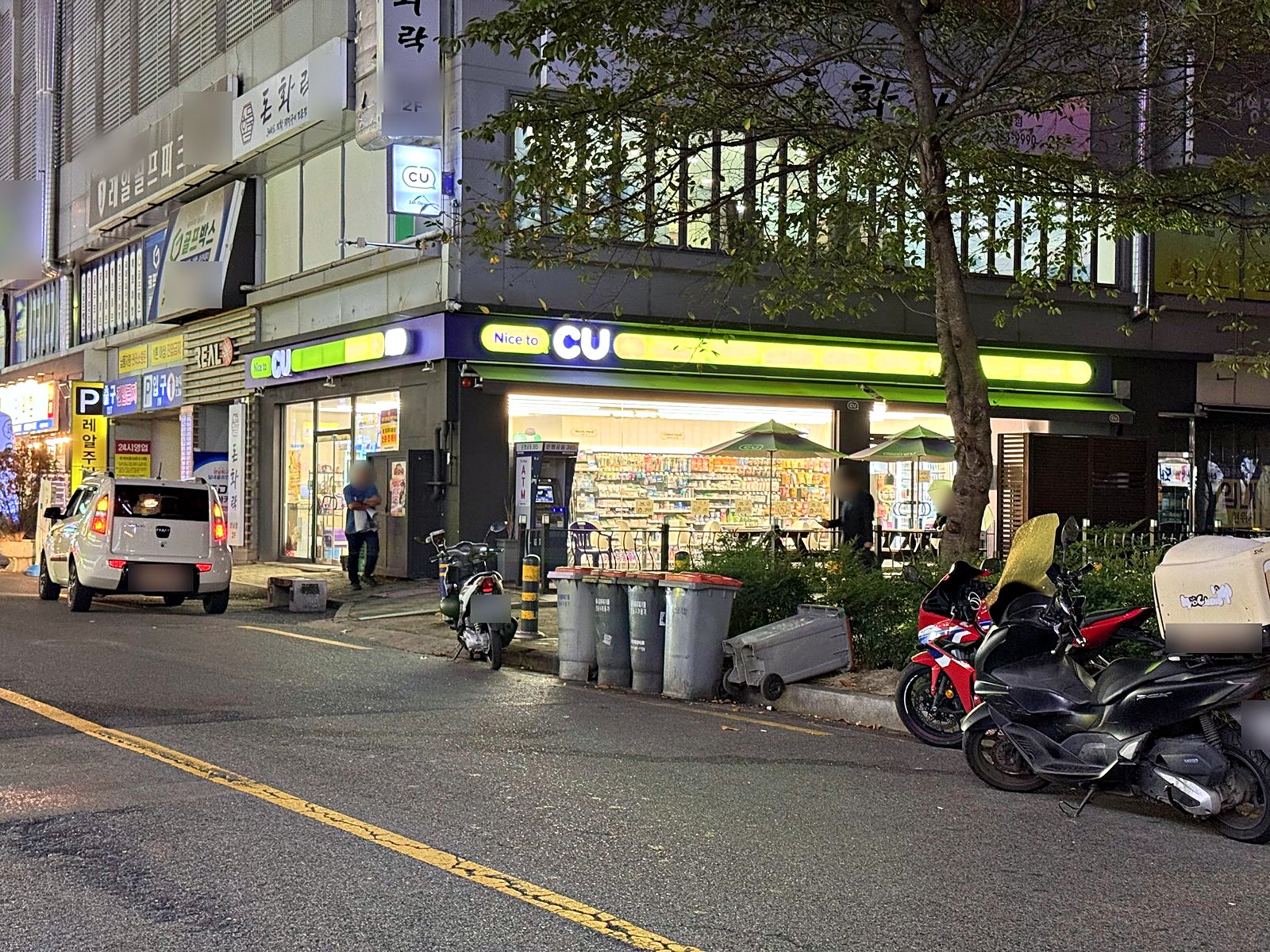
A CU convenience store at night. Photo: Jin from Korea
How 1+1 and 2+1 Deals Work
Look for 1+1 and 2+1 on the shelf tags. Check which products qualify before you take them to the counter.
- 1+1: buy one, get one free. Pick up two of the same item (or, on some deals, two items from the same range) and you pay for one.
- 2+1: buy two, get a third free. Bring three to the counter and pay for two.
- Bring all of them to the counter: the free item is not added automatically. If you only take two on a 2+1 deal, you simply pay for two.
- Deals change often: they usually run for a set period, often a month, and differ between chains and sometimes between stores.
Deals are common on drinks, milk, snacks, instant noodles and even canned food. On the shelf in my photo, a 200 ml carton of Seoul Milk was around ₩1,200 with a 2+1 tag, so three cartons came to around ₩2,400.
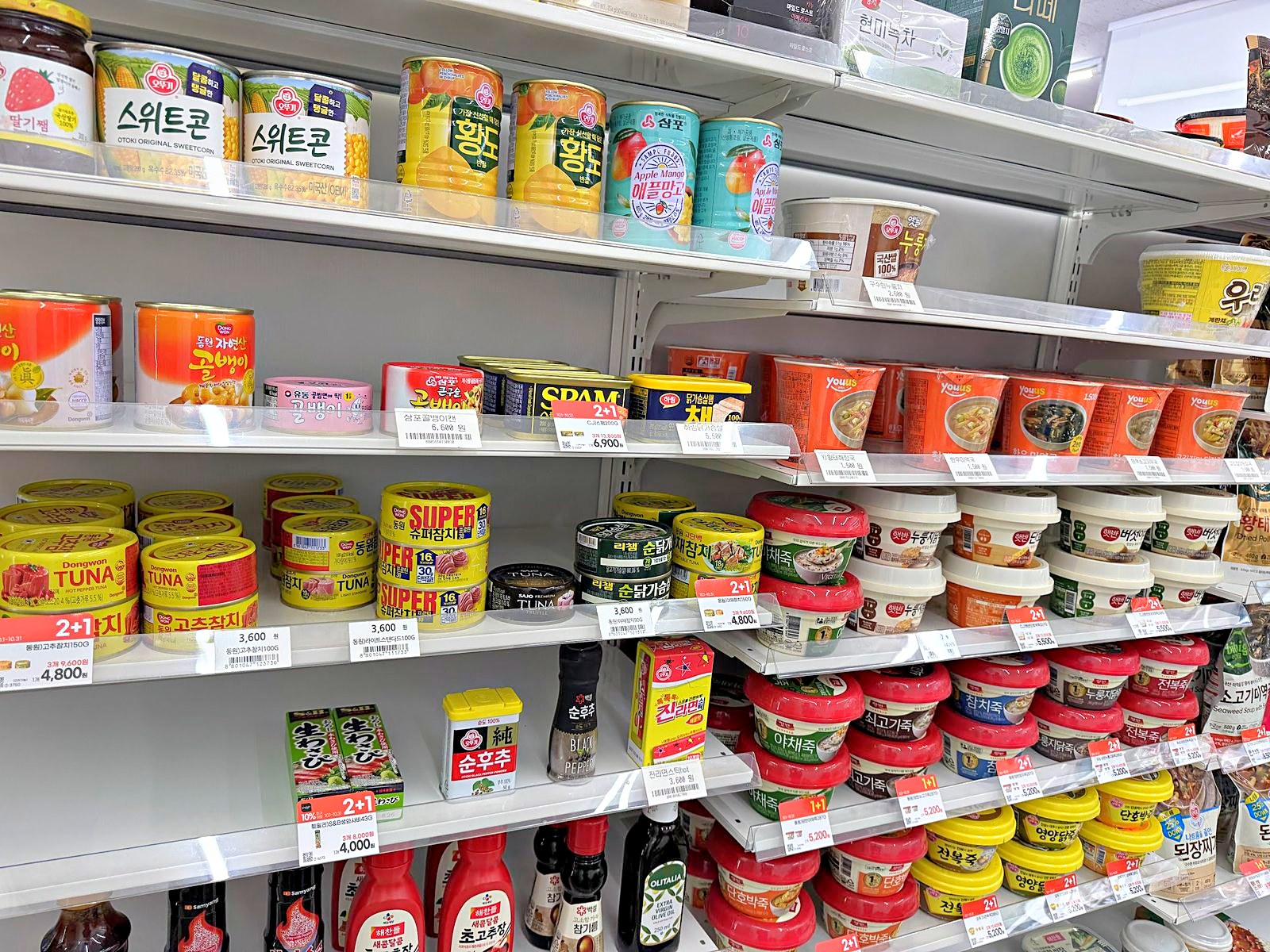
Canned food, instant rice and soups with 2+1 deals at a Korean convenience store. Photo: Jin from Korea
How to Use Korean Convenience Store Ice Cups
- Find an ice cup. It is in a freezer, often near the drinks. If you cannot find it, ask the staff (the phrase is in the Korean box below).
- Pick your drink. Pouch drinks are made for this: they come in soft packs, ready to pour over ice. Iced coffee pouches, such as Lotte Chilsung’s Cantata Ice range, sit next to fruit teas, lattes and ades. Banana milk works too.
- Pay for both. The ice cup is a separate item at the till. Some stores sell sets of a pouch drink and an ice cup at one price.
- Pour and enjoy. Peel the lid, pour, and stir with a straw if the store has them at the counter.
At the GS25 in my photos, the ice cups were around ₩800 (medium), ₩1,000 (large) and ₩1,400 (extra large). A large melon latte pouch with a large ice cup was sold as a set for around ₩2,800, and a peach iced tea pouch set for around ₩2,100.
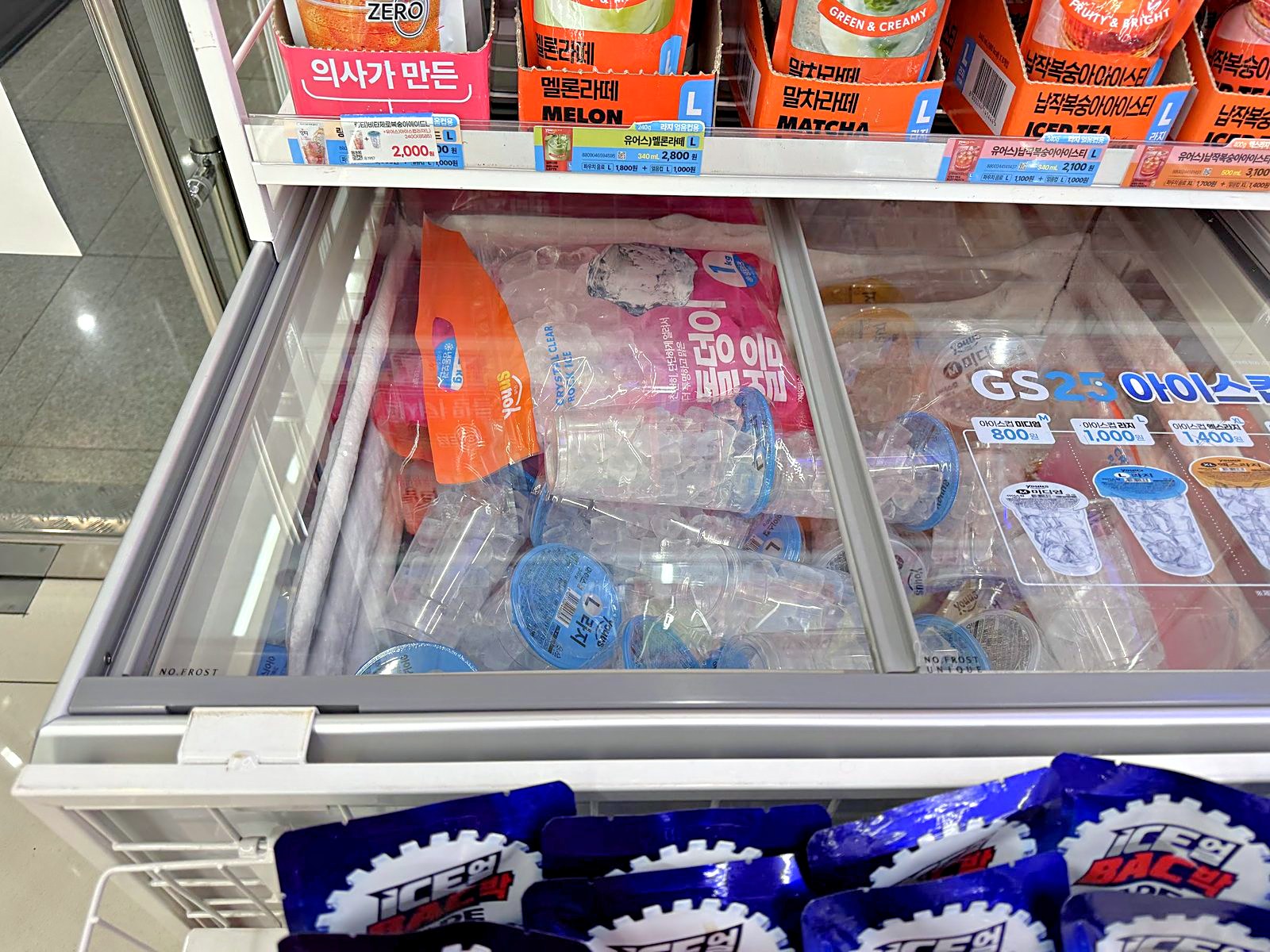
Sealed cups of ice in the freezer. Photo: Jin from Korea
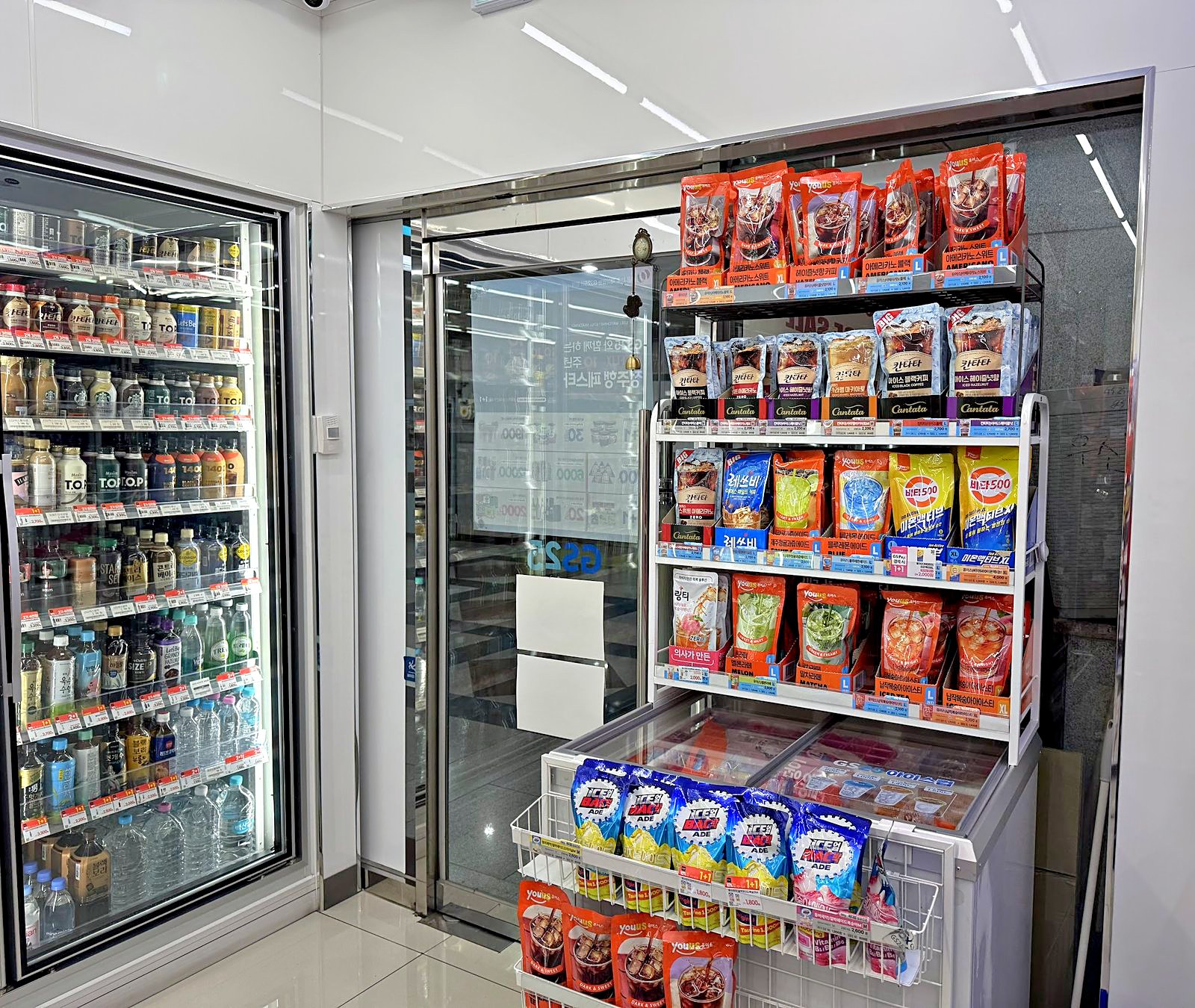
Pouch iced coffee and cup ice at a Korean convenience store. Photo: Jin from Korea
Binggrae Banana Milk: The Must-Try
If you only buy one thing, make it Binggrae Banana Flavored Milk (바나나맛우유, banana-mat uyu). It has been around since 1974, and the short, round bottle, inspired by a traditional Korean moon jar, has barely changed. Binggrae calls it Korea’s number one flavored milk, and most Koreans have a childhood memory of drinking it.
It is sweet, smooth and lightly banana flavored, best drunk cold. The same jar shape also comes in strawberry, melon and other flavors. On the shelf in my photo, the jar bottles were around ₩1,800 each. You will also find milk cartons, drinking yogurts and coffee milks, many with 1+1 or 2+1 tags.
Banana milk is also a great match for hodugwaja, the warm walnut cakes sold at Korean highway rest stops; I wrote about how to order them at the kiosk after a stop at Eonyang Rest Area.
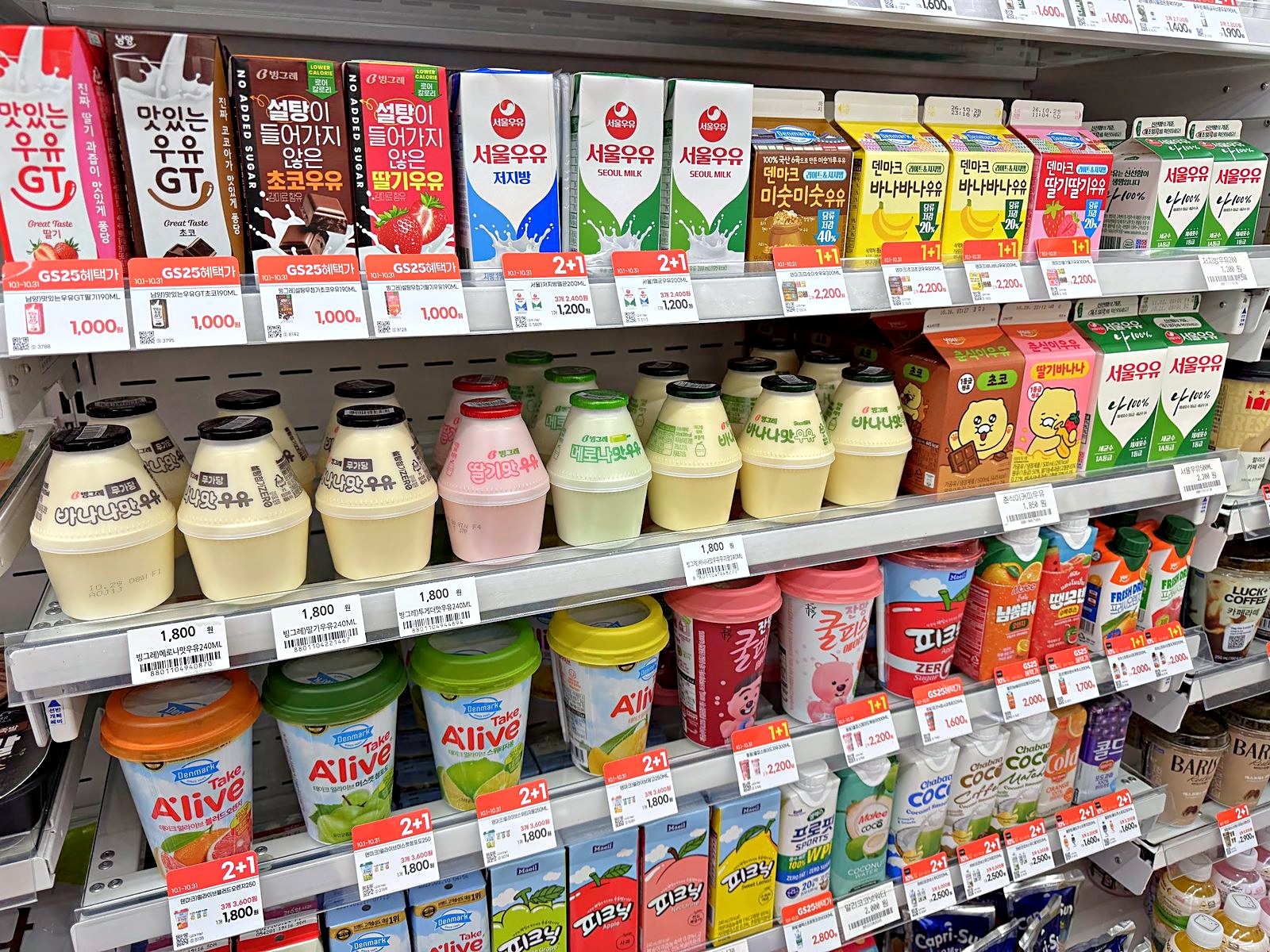
Banana milk and other flavored milks at a Korean convenience store. Photo: Jin from Korea
Snacks Worth Trying
For a snack to share, pick by flavor or texture:
- Kkobuk Chip (꼬북칩): layered, extra crunchy corn chips in several flavors.
- Shrimp and seafood crackers: a classic Korean snack with a light, salty sea flavor.
- Dried squid: a savory, chewy snack that Koreans love with a drink.
Around November 11, this same aisle fills up with Pepero and other stick snacks for Pepero Day. I explain who gives them to whom in my Pepero Day guide.
If you enjoy them, try Korean street snacks next; my bunsik guide covers tteokbokki, gimbap and more.
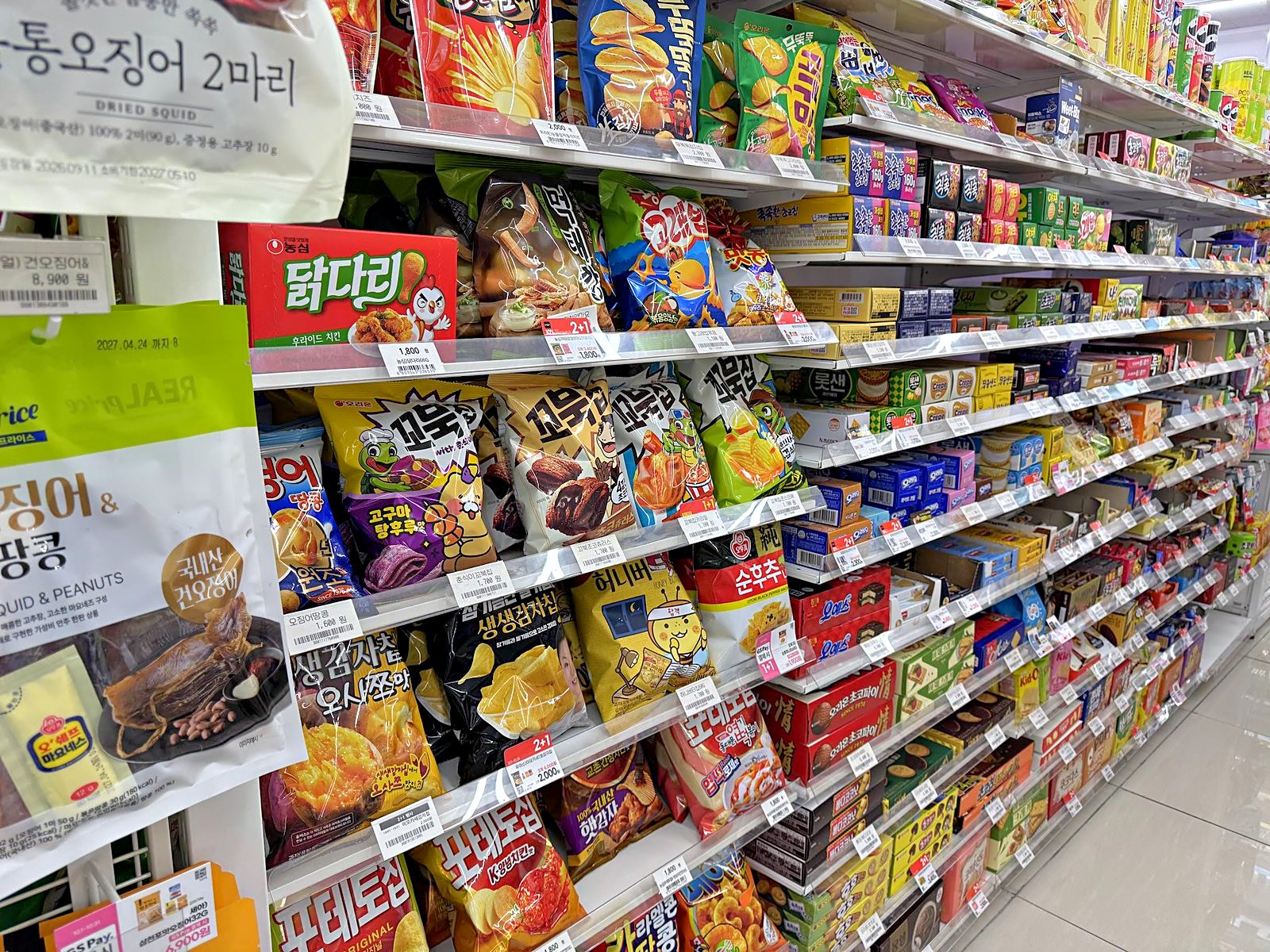
The snack aisle at a Korean convenience store. Photo: Jin from Korea
Quick Meals: Instant Rice, Ramyeon and Lunchboxes
Choose something you can eat on the move or a meal you can heat at the store:
- Cup ramyeon: a whole wall of instant noodles, from mild to very spicy.
- Triangle gimbap (삼각김밥): a small, seaweed-wrapped rice snack that’s easy to take with you.
- Dosirak (도시락): a fuller lunchbox with rice and side dishes. Check the package for heating instructions.
- Instant rice and soups: microwaveable rice bowls, porridge and soups, plus canned tuna and other canned food.
Many stores have a hot water dispenser and a microwave for customers, and some have a small counter or a few tables where you can eat. Follow the instructions on the package, and if you are not sure, ask the staff to heat it for you. Not every store has seating, especially small ones.
For a proper sit-down Korean meal with free side dishes, read my banchan guide.
Paying: Cards, Cash and T-money
- Cards: most convenience stores accept major international credit and debit cards, even for small purchases. Bring a physical card as a backup in case a phone wallet does not work.
- Cash: always accepted, and good to keep a little of for small markets and street food.
- Pay with T-money: a T-money card with a balance can also pay at the counter in many stores.
Topping up your T-money card
Convenience stores are one of the easiest places to top up a T-money card. Hand the card and cash to the staff and say how much you want to add. At stores displaying the T-money logo, ask to top up in units of ₩1,000. Top-ups at the counter are done with cash, so do not expect to use a foreign credit card for this. You can also buy a T-money card at many convenience stores. Everything else is in my T-money card guide.
Getting Cash: Bank-Shared ATMs at Convenience Stores
Many convenience stores have an ATM inside or right by the door. You may see machines labeled 은행공용 ATM (eunhaeng gongyong), which means a bank-shared ATM that works with cards from many Korean banks. These are handy late at night, but there are a few things to know as a visitor:
- Not every ATM takes foreign cards. Look for a “Global” sign or the logos of international card networks on the machine. If your card is rejected, try another machine or a bank ATM.
- Fees vary. The official Seoul tourism site notes that convenience store ATMs often charge higher fees than bank ATMs, and your own bank may add its own fee.
- Choose won, not your home currency, if the screen offers a conversion, as the ATM’s exchange rate is often worse.
- Check with your bank before you fly that your card works abroad.
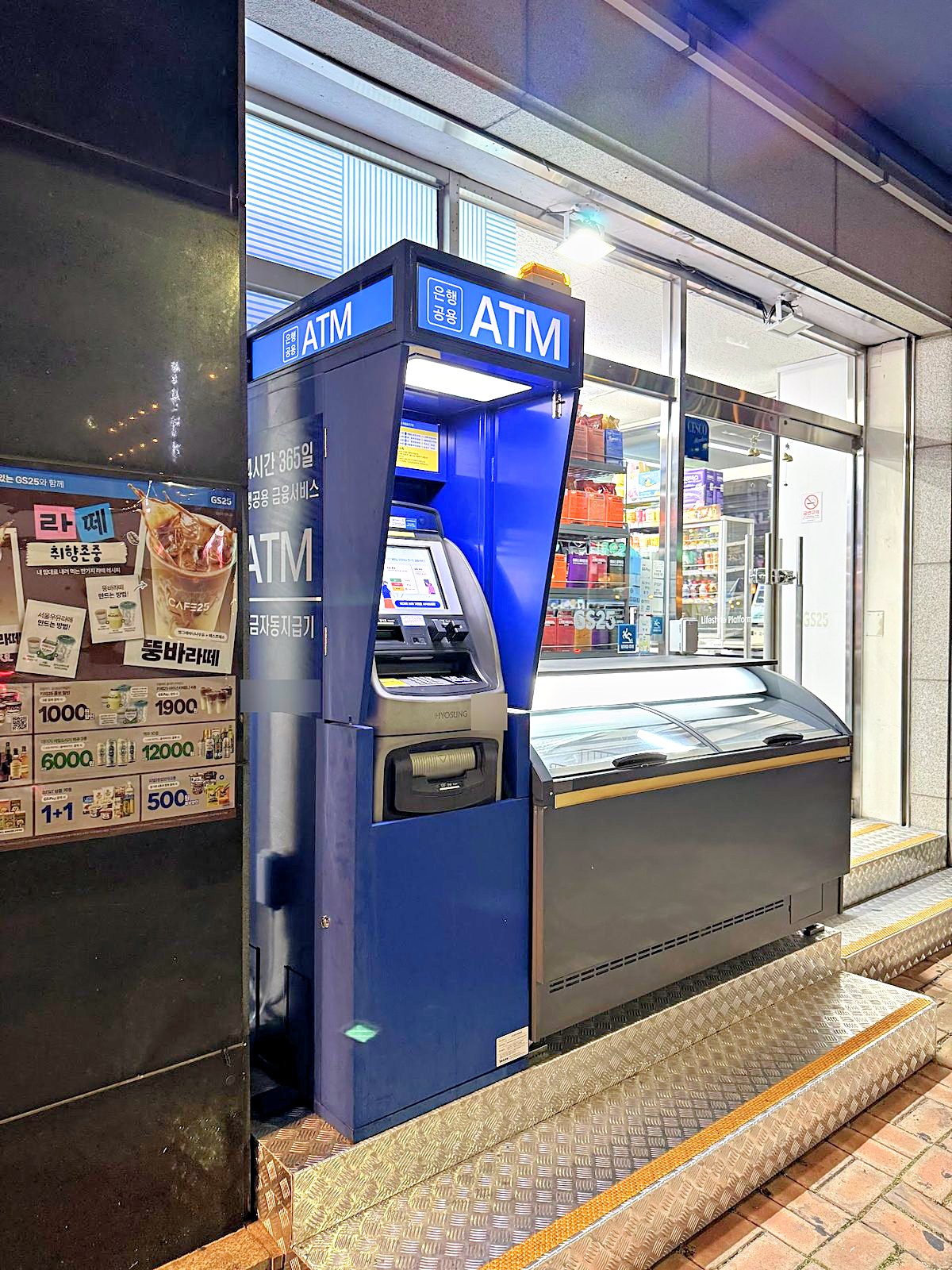
A bank-shared ATM outside a convenience store. Photo: Jin from Korea
Practical Tips and Etiquette
- Bags are not always free: you may be asked whether you need a bag, and you may have to pay a little for one. Carrying a foldable shopping bag makes life easier.
- Clean up after yourself: if you eat in, throw away your trash, pour leftover soup where the store indicates, and wipe the table.
Find a Convenience Store
Open a Naver Map search on Wi-Fi or mobile data and choose a store near you.
- 편의점 (convenience store) — Open in Naver Map
- GS25 — Open in Naver Map
- CU — Open in Naver Map
New to Naver Map? See my Google Maps vs Naver Map vs KakaoMap guide.
If you need a connection away from your accommodation, see my eSIM vs SIM vs pocket WiFi guide.
Shopping and T-money Phrases
Copy the Korean text into Naver Map or Papago, or show it on your phone.
Words
- 편의점 (pyeonuijeom) — convenience store
- 바나나맛우유 (banana-mat uyu) — banana milk
- 얼음컵 (eoreumkeop) — ice cup
- 봉투 (bongtu) — bag
- 영수증 (yeongsujeung) — receipt
- 젓가락 (jeotgarak) — chopsticks
Phrases
- 얼음컵 어디 있어요? (eoreumkeop eodi isseoyo?) — Where are the ice cups?
- 봉투 주세요. (bongtu juseyo.) — A bag, please.
- 카드 돼요? (kadeu dwaeyo?) — Do you take cards?
- 데워 주세요. (dewo juseyo.) — Please heat it up.
- 티머니 충전해 주세요. (timeoni chungjeonhae juseyo.) — Please top up my T-money.
- 젓가락 주세요. (jeotgarak juseyo.) — Chopsticks, please.
Plan the Rest of Your Trip
A convenience store run is one of the easiest ways to feel at home in Korea. Grab a banana milk, try the ice cup trick and stock up on snacks for the train. For drugstore and beauty shopping with the same 1+1 idea, see my Olive Young Korea shopping guide. For getting around, set up your T-money card, and for transport, money, apps and where to stay in one place, start with my Korea trip planner for first-timers. Enjoy your snacks!
Leave a Reply